
Rectangle with a notch area bounds
Rectangle with a notch area bounds
Rectangle with a notch area bounds · L,U
- 140 bytes
- COMP mode
Worked examples
Example 1
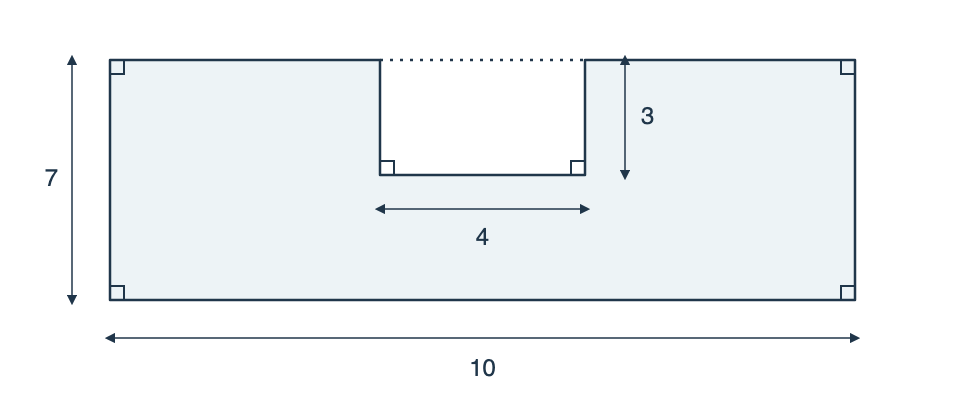
A rectangular wooden board is 10 cm wide and 7 cm high. A rectangular notch 4 cm wide and 3 cm deep is cut from the middle of its top edge, without reaching either side edge. All four lengths are measured correct to the nearest 1 cm. Let S cm² be the actual area of the remaining board. Find the range of values of S.
Answer
Standard solution (without a calculator)
- Limits of the lengths: the maximum error is 0.5 cm: 9.5 ≤ width < 10.5, 6.5 ≤ height < 7.5, 3.5 ≤ notch width < 4.5 and 2.5 ≤ notch depth < 3.5.
- Area model: S = width × height − notch width × notch depth. A larger board increases S, while a larger notch decreases S.
- Least area: take the smallest board and the largest notch: 9.5 × 6.5 − 4.5 × 3.5 = 61.75 − 15.75 = 46.
- Greatest area: take the largest board and the smallest notch: 10.5 × 7.5 − 3.5 × 2.5 = 78.75 − 8.75 = 70.
- Endpoints: 46 needs the notch at its excluded upper limits, and 70 needs the board at its excluded upper limits, so neither value can be reached. Hence 46 < S < 70.
Example 2
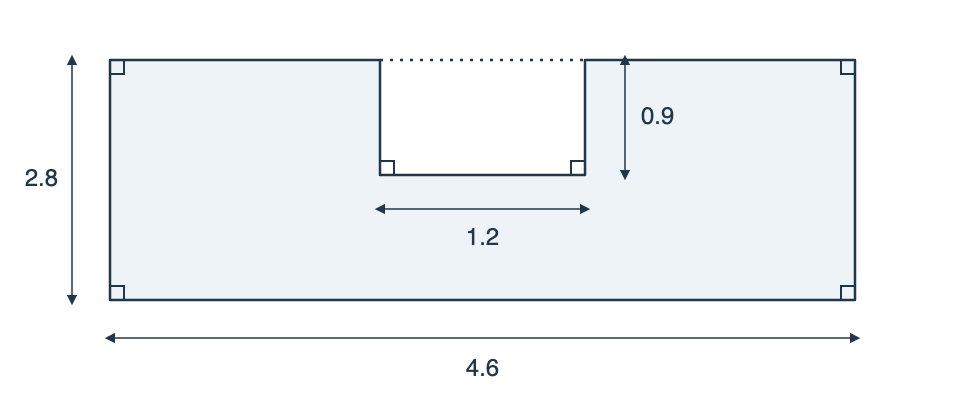
A rectangular metal sheet is 4.6 m wide and 2.8 m high. A rectangular notch 1.2 m wide and 0.9 m deep is cut from the middle of its top edge, without reaching either side edge. All four lengths are measured correct to the nearest 0.1 m. Let S m² be the actual area of the remaining sheet. Find the range of values of S.
Answer
Standard solution (without a calculator)
- Limits of the lengths: the maximum error is 0.05 m: 4.55 ≤ width < 4.65, 2.75 ≤ height < 2.85, 1.15 ≤ notch width < 1.25 and 0.85 ≤ notch depth < 0.95.
- Least area: smallest sheet and largest notch: 4.55 × 2.75 − 1.25 × 0.95 = 12.5125 − 1.1875 = 11.325.
- Greatest area: largest sheet and smallest notch: 4.65 × 2.85 − 1.15 × 0.85 = 13.2525 − 0.9775 = 12.275.
- Avoid a common slip: taking all four lengths at their lower limits gives 4.55 × 2.75 − 1.15 × 0.85 = 11.535, which is not the least area. The notch is subtracted, so it must be at its largest for the least area.
- Conclusion: neither bound can be reached, so 11.325 < S < 12.275. Keep all the decimal places.
Example 3
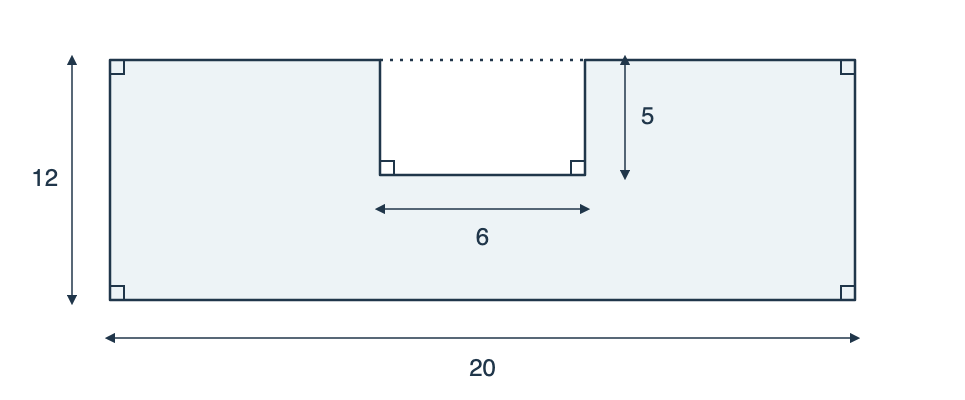
A rectangular display card is 20 cm wide and 12 cm high. A rectangular notch 6 cm wide and 5 cm deep is cut from the middle of its top edge, without reaching either side edge. All four lengths are measured correct to the nearest 1 cm. Let S cm² be the actual area of the remaining card. Find the range of values of S.
Answer
Standard solution (without a calculator)
- Limits of the lengths: the maximum error is 0.5 cm: 19.5 ≤ width < 20.5, 11.5 ≤ height < 12.5, 5.5 ≤ notch width < 6.5 and 4.5 ≤ notch depth < 5.5.
- Least area: smallest card and largest notch: 19.5 × 11.5 − 6.5 × 5.5 = 224.25 − 35.75 = 188.5.
- Greatest area: largest card and smallest notch: 20.5 × 12.5 − 5.5 × 4.5 = 256.25 − 24.75 = 231.5.
- Check: the area from the measured values is 20 × 12 − 6 × 5 = 210, and 210 ± 0.5 × (20 + 12 + 6 + 5) = 210 ± 21.5 gives the same two bounds.
- Conclusion: neither bound can be reached, so 188.5 < S < 231.5.
When to use it
Use this when a rectangular notch of width c and depth d is cut from a rectangle of width a and height b, and all four lengths are measured correct to the nearest u. The remaining area is S = ab − cd. It increases with the outer dimensions and decreases with the notch dimensions, so the least area uses the smallest board with the largest notch, and the greatest area the largest board with the smallest notch.
Enter the known values
- X: the rounding unit u (1 for “nearest 1 cm”, 0.1 for “nearest 0.1 m”). A: outer width a; B: outer height b; C: notch width c; D: notch depth d.
- Enter the five values in this order and in one length unit. Type a number at every prompt: a blank EXE reuses whatever the variable held before.
Read the results
- The first screen shows the lower bound L; press EXE to see the upper bound U. Write the answer as L < S < U in square units: neither bound can be reached.
- A single −1 means the input failed a check listed below; it is not an area.
Question types
- Original practice at HKDSE Mathematics Compulsory Part level (approximation and errors): the range of the area left after a rectangular piece is cut from a rectangular board, card or sheet measured correct to the nearest unit.
Before you start
- Use COMP. The demonstration stores the program in P1, but any empty program area with 140 bytes free works (P1–P4 share 680 bytes). The setup steps clear P1, so back up an existing program there or use another area and change the area number.
- Both the board and the notch must be rectangles with the notch inside the board's width and height. It does not handle irregular concave polygons.
- Valid input: u > 0, every length > u ÷ 2, a − c ≥ u, b − d ≥ u and a + b + c + d ≤ 10⁸u. Any failed check displays −1.
- a − c ≥ u and b − d ≥ u make sure the actual notch is always narrower and shallower than the actual board.
- Both bounds are excluded: the lower bound needs the notch at its excluded upper limits, and the upper bound needs the board at its excluded upper limits. The answer is L < S < U.
- Use ordinary inputs of up to 10 significant figures. The program sets the display to Norm 2 and overwrites X, A, B, C, D, Y and M.
- After reading U, press AC to leave; pressing EXE again restarts the program.
Checking access…